Quick Answer
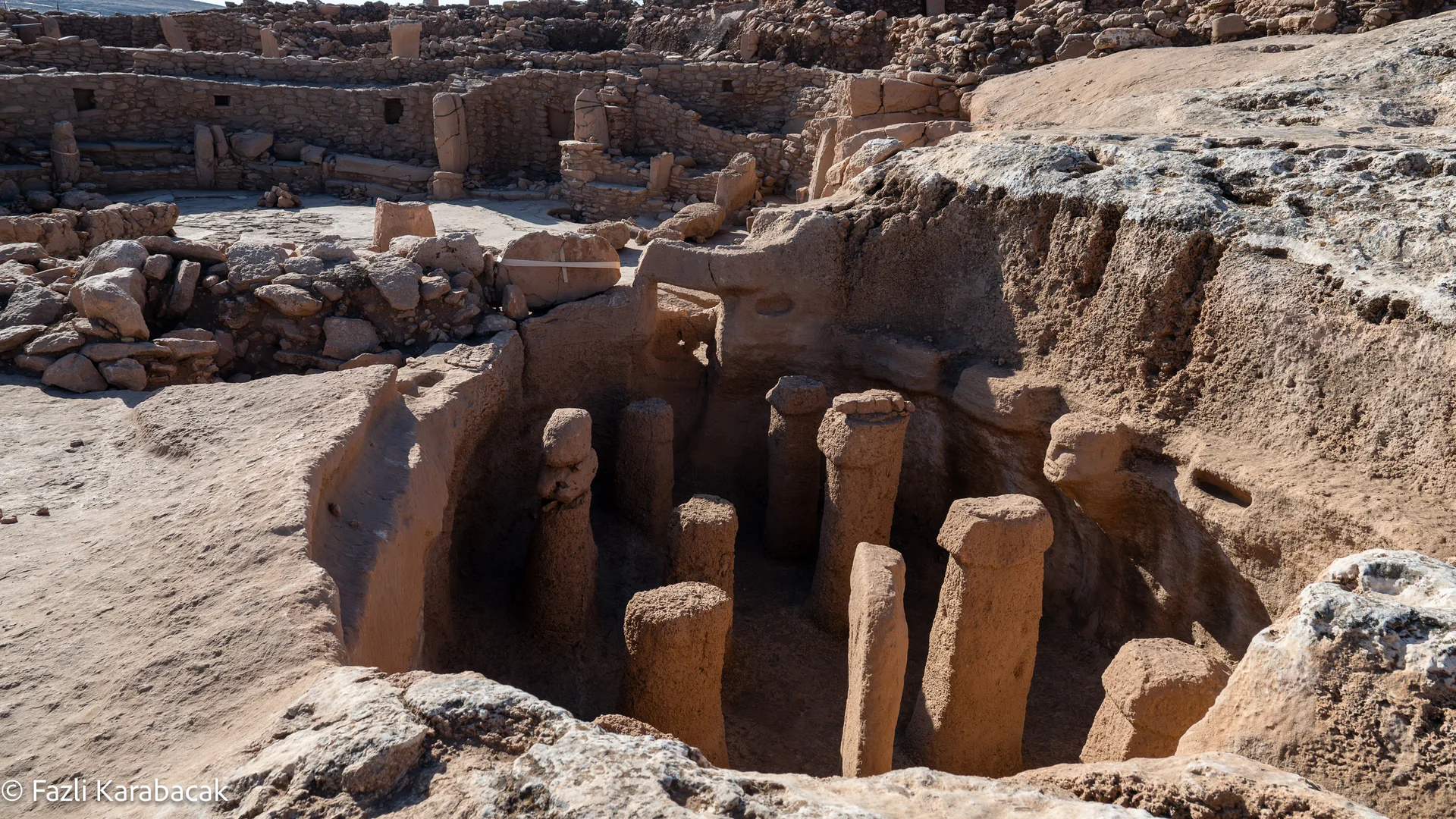
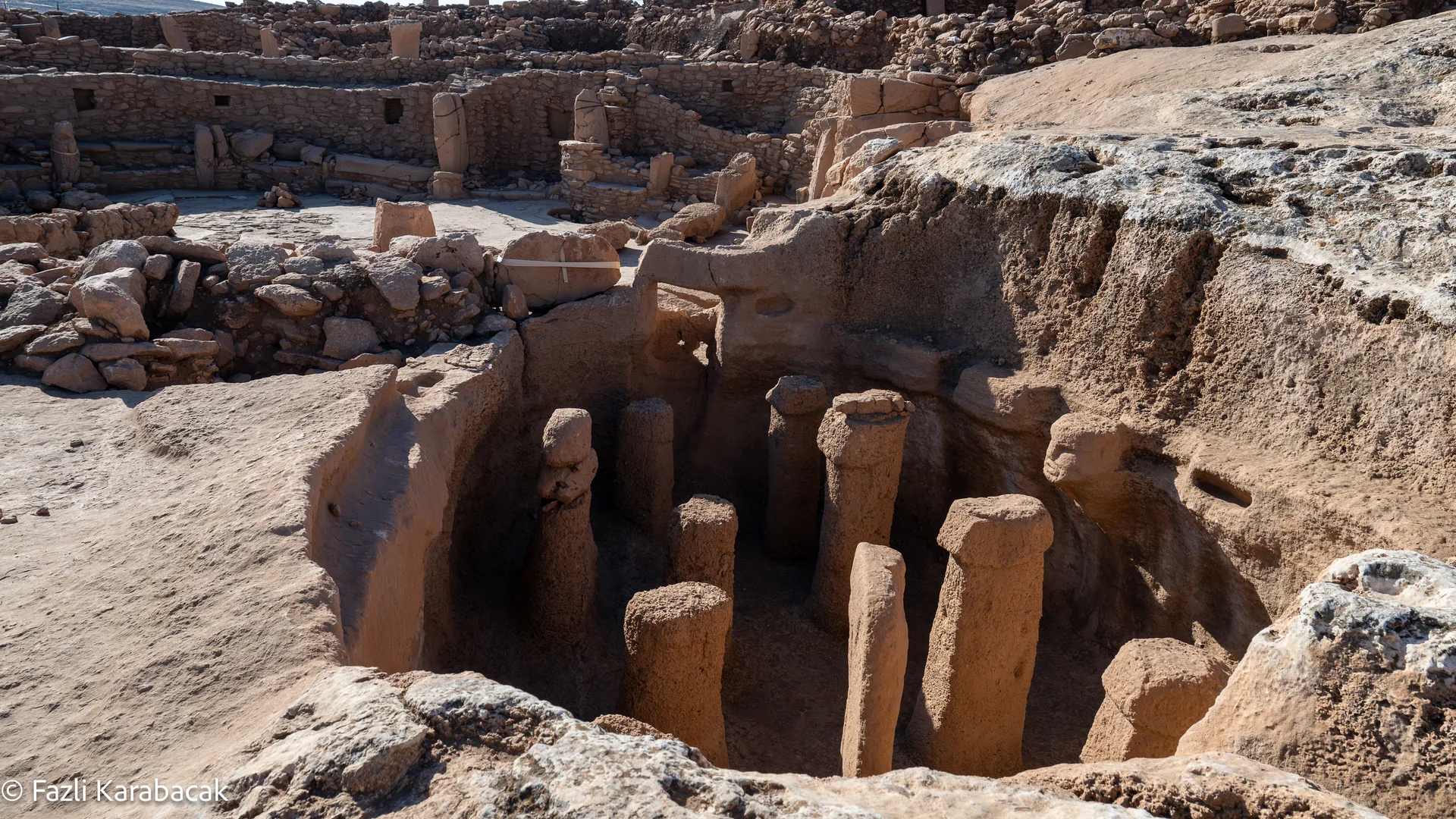
Karahan Tepe’s connected Structures AD, AB and AA, often nicknamed the Great Ellipse, Pillars Shrine and Pit Shrine, combine rock-cut architecture with built elements. AB contains ten phallus-shaped bedrock pillars and a separately inserted eleventh stone element, plus a human head projecting from its western wall. Karul’s 2021 report records entry to AB principally through AD and a connection onward to AA. A ceremonial route is his preliminary interpretation, not a recovered ritual script. The northern serpentine channel is a winding feature, not by itself proof of a snake relief or a pedestrian route.
At a Glance
- Excavator: Prof. Dr. Necmi Karul (Istanbul University), systematic excavations since 2019
- Structures: AD (Great Ellipse, 23 × 20 m) → AB (Pillars Shrine, 7 × 6 m) → AA (Pit Shrine, 8.5 × 7 m)
- Connections: primary entry to AB from AD; another connection from AB to AA
- Eleven elements in AB: 10 phallus-shaped bedrock pillars + 1 separately inserted stone element
- Western-wall head: a human head turned slightly toward the entrance stairs, with two nearby niches
- Loincloth choice: leopard-pelt at Karahan Tepe (vs. fox-pelt at Göbekli Tepe’s Enclosure D)
- Building closure: Karul interprets AB’s staged filling as intentional; its motive remains open
These three rooms invite a question that a plan alone cannot answer: what did moving between them mean? After 23 years of professional guiding, I still find the relationship between architecture and experience one of the most rewarding ways to explain an ancient place. “A journey” is my interpretive description here, not a claim to have witnessed a Neolithic ceremony or to have entered restricted excavation areas.
Systematic excavations began in 2019 under Professor Necmi Karul of Istanbul University. Structures AD, AB and AA form an interconnected complex with both carved bedrock and masonry construction. Their use and closure must be reconstructed from the evidence in each room.
An especially striking aspect of Karahan Tepe is space subtracted from solid stone. That rock-cut work is prominent in AB, although AD also includes masonry and separately installed pillars. It is not a simple opposition between a wholly carved site here and a wholly built site at Göbekli Tepe.
What makes these chambers remarkable is not just their individual features — benches, pillars, heads and animal imagery — but their connections. Entry from AD to AB and a further connection to AA support discussion of movement through the complex. Karul separately records a serpentine channel opening into AB from the north; this should not be described as a corridor that physically directed people’s feet.
Structure AD: The Great Ellipse — A Hall of Giants
Structure AD is the central and largest unit of the complex, and it is the space that most visitors see first. Popularly called the Great Ellipse for its roughly oval plan, it measures approximately 23 by 20 metres — roughly the footprint of a basketball court, comparable in scale to the largest enclosures at Göbekli Tepe, though fundamentally different in construction.
The northern, eastern, and southern perimeter walls are built from dry-stone masonry roughly 1.5 metres thick. Set into this wall at regular intervals were originally eighteen T-shaped pillars, between which stone benches were placed — a layout that mirrors the arrangement found at Göbekli Tepe’s Enclosure D and at Nevalı Çori. At least one surviving bench top is clearly the recycled stem of an older T-shaped pillar, still bearing carved decoration on its front narrow edge. This recycling tells us something about the long duration of the building’s use: it was modified and repaired over generations.
At the centre of this great space, two enormous T-shaped pillars once stood in holes cut into the bedrock. Today they survive only as fragments scattered across the floor. Piecing the fragments together suggests they were just slightly smaller than the unfinished monolith still attached to the bedrock quarry on the hill’s western slope — a block approximately 5.5 metres long. These central pillars, like their counterparts in Enclosure D, would have dominated the interior space.
Structure AD’s western half is especially distinctive.
The Thrones and Buttresses
The western section of Structure AD was carved directly from the hillside’s limestone. Three large benches hewn from the rock give it a distinctive character. The word “throne” is an analogy: imagining elders seated there in firelight may convey scale, but their identities, authority and season of use are not established by the benches themselves.
Separating the three thrones are towering rock-cut buttresses, originally four in number though only three survive intact. Each rises to a maximum height of 4.3 metres from ground level, carved entirely from the eastern slope. These buttresses functioned as monolithic alternatives to the T-shaped pillars that lined the rest of the enclosure. Karul’s team has confirmed their anthropomorphic character: at least two of the three surviving examples display carved relief showing what archaeologists at the site interpret as leopard-pelt loincloths below their presumed waistlines.
This detail is extraordinarily important. At Göbekli Tepe’s Enclosure D, the two central pillars — Pillars 18 and 31, the most elaborate carvings at the entire site — are depicted wearing fox-pelt loincloths held by carved belts, with human arms and hands reaching toward the front. The leopard-pelt loincloths at Karahan Tepe suggest a parallel but distinct tradition: both communities dressed their anthropomorphic beings in animal skins, but the choice of animal differed. Fox at Göbekli Tepe, leopard at Karahan Tepe. Different totem, shared grammar.
Reliefs of animals adorn the sides of the rock buttresses. On the south side of the most southerly buttress, a standing quadruped — possibly a leopard — faces the hillslope with its legs upright, oriented toward the person who would have been seated on the throne beside it. Limestone statues, carved platters, and bowls were found on and around the benches — objects that Karul interprets as having been deliberately left in place when the structure was decommissioned.
Structure AB: The Pillars Shrine — Where Stone Becomes Spirit
If the Great Ellipse is imagined as a public hall, Structure AB can feel like an inner chamber; “inner sanctum” remains an interpretation. Connected to AD’s north-northwestern side through a remarkable porthole window — a 70-centimetre rectangular opening cut from a thin wall of rock deliberately left in situ for this purpose — the Pillars Shrine is accessed by descending five crudely carved steps from the porthole into a space that feels utterly unlike anything else in the Neolithic world.
Carved entirely from the hillside, Structure AB is trapezoidal in shape with rounded corners, measuring approximately 7 by 6 metres. Its southern end is narrower than its northern end, and its limestone walls rise to 2.3 metres — tall enough to stand in, but low enough to create a sense of enclosure that is almost claustrophobic. Beyond the wall tops, the artificially levelled rock surface suggests that the shrine was originally roofed, perhaps with wooden beams resting on horizontal ledges visible at the same height on both the eastern and western walls.
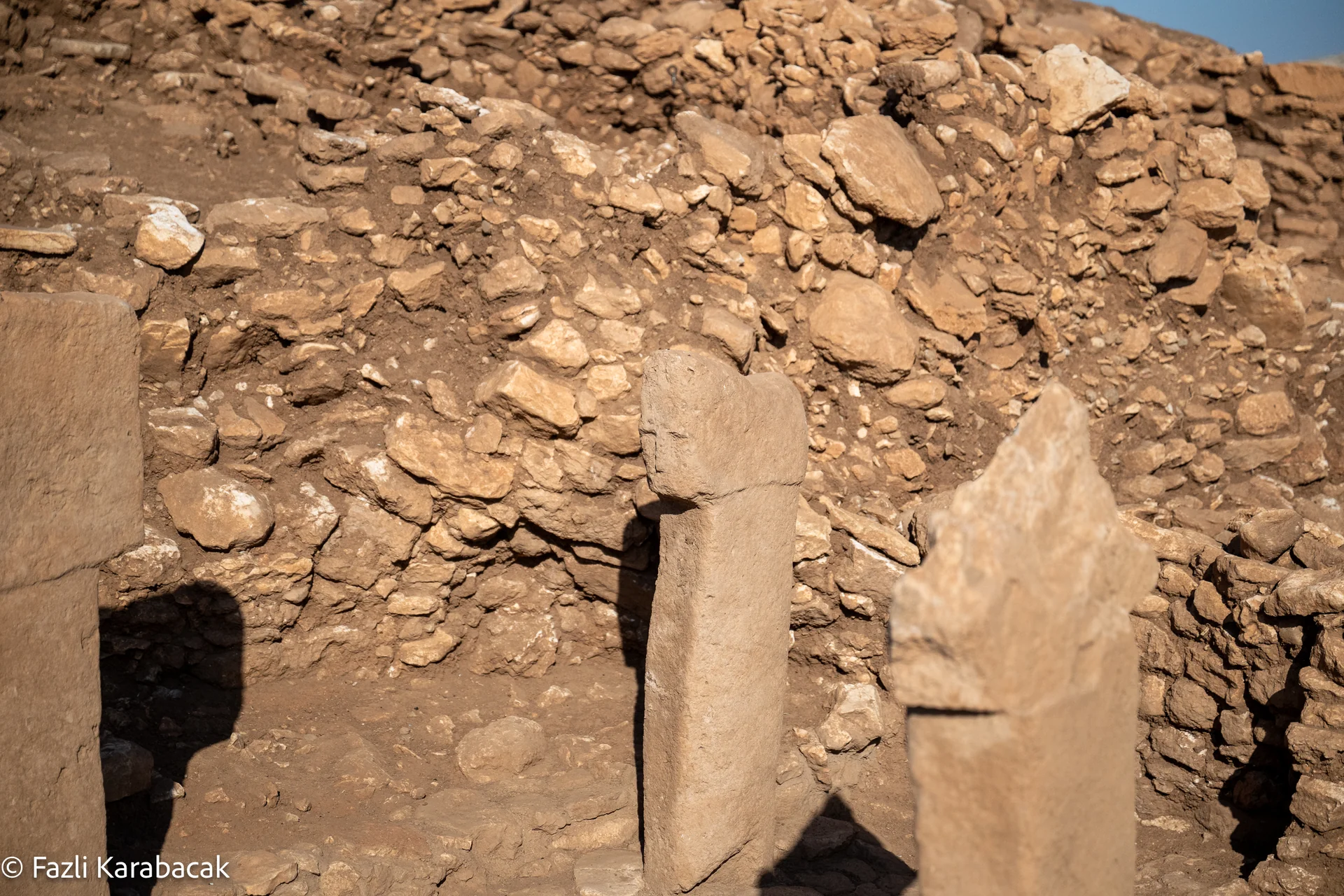
Eleven standing pillars fill the interior. What makes this extraordinary is that ten of them were not quarried and transported — they were carved directly from the bedrock itself, the surrounding rock having been chipped and carved away to leave them standing as freeform columns emerging from the floor. Four of the largest pillars line up along the western wall, each approximately 1.6 to 1.7 metres tall with slightly wider heads that give them an unmistakably phallic appearance. The six smaller pillars in the back rows range from 1 to 1.4 metres in height and 30 to 50 centimetres in diameter, five of them positioned in a zigzag pattern.
The pillar spacing would have affected movement inside the chamber. Reading that movement as a ritual procession is a hypothesis; it does not establish a prescribed sequence of steps or identify the people involved.
The Eleventh Element: Separately Installed
The eleventh element differs in construction: it was fashioned separately and placed into a shallow socket rather than left attached to the bedrock. Karul describes it as a flat stone element. Its shape has prompted other readings, but manufacture and placement are the secure starting points.
Calling it a “striking snake” or genius loci — a guardian spirit — is a modern symbolic interpretation. The 2021 excavation report does not establish that identification. Such readings should not be built into the pillar count as archaeological fact.
The Giant Stone Head
The Pillars Shrine’s best-known feature is a human head projecting from a ridge on its western wall. It was carved from the bedrock and turns slightly toward the entrance stairs. It is not a full statue standing in the centre, nor the separate 2.3-metre seated figure announced in 2023.
Some later writers describe the support beneath the head as serpent-like. That resemblance is an interpretation, not an established hybrid identity. The ancient roof and the meaning of the head remain subjects for reconstruction.
Karul describes a protruding forehead, thick lips and a beard under the chin. These features belong to the head. His next observation concerns two small niches on the nearby bench; it does not say that the niches contain two additional faces.
The opening and head have inspired a winter solstice hypothesis, based on a reported modern illumination. Whether the ancient roof and surrounding structures allowed the same effect, and whether it was intentional, need independent assessment. A possible alignment is not yet a demonstrated calendar.
The room invites questions about how space shapes attention. Initiation, divination and rites of passage are possible narratives to discuss, not activities we can name with certainty.
Planning a guided visit: Explore Turkey itineraries with Serendipity Turkey and confirm available viewing routes before travelling.
Structure AA: The Pit Shrine — Where the Journey Ends
Karul records a connection from AB to AA, as well as the primary entrance through AD. The northern winding channel is a distinct feature. Its shape and proximity to the rooms do not establish that people walked through it or that it was a carved snake.
Structure AA — the Pit Shrine — is trapezoidal with rounded corners, approximately 8.5 by 7 metres. At just over 1.1 metres deep, it is much shallower than the other two installations, creating a very different spatial experience: where the Pillars Shrine enclosed you in its rock walls, the Pit Shrine opens you to the sky.
Along the western wall runs a curved bench approximately 3.6 metres long. On its front vertical face, an extremely long snake has been incised using the scraping technique — a method that involves scratching the design into the limestone surface rather than carving in relief. The snake’s head displays two incised eyes and turns upward, facing north. Immediately beyond the snake’s head is a standing fox, also in incised relief, also facing north. The pairing is deliberate: the two creatures face the same direction and occupy the same register, suggesting a specific narrative relationship between them. A small niche cut beneath the fox’s chin — a detail easily missed — may have served as a receptacle for offerings.
Cut into the floor at the room’s northern end is an irregularly shaped pit with rounded corners, descending approximately 2.3 metres into the bedrock. At ground level on its western side, a carved recess is large enough for a person to crawl inside. The function of this pit is among the site’s greatest mysteries. Was it used for ritual immersion? For the storage of sacred objects? For interment of the dead? Or for something we have no ethnographic parallel to imagine? The evidence, for now, does not settle the question.
The Processional Route: Understanding the Complex as a Whole
Karul proposes a ceremonial route based on the main entry from AD into AB and the connection from AB to AA. This is an excavation-led hypothesis about the connected plan. It does not identify who participated, what words or actions were involved, or whether a supposed serpent guardian was part of their beliefs.
The opening and stairs constrain movement, which makes a processional interpretation worth exploring. Calling the entrant a “supplicant” or the movement a passage “between worlds” adds a religious reading that the architecture alone cannot prove.
If this reading is correct, the connected rooms offer an important example of deliberately organised ceremonial movement. Describing them as the first initiatory architecture would require evidence both for initiation and for a secure comparison with other Neolithic buildings.
The Burial: Putting the Rooms to Rest
Karul’s 2021 article gives a detailed argument for intentional filling in AB. That argument should not become an assertion that all three rooms, the whole settlement or every Taş Tepeler site underwent an identical burial ritual.
Structure AB, the Pillars Shrine, was filled in a meticulous sequence. First, a reddish-buff soil containing flat limestone pieces was spread across the floor. Then larger stones were positioned between and atop the pillars. Finally, oversized flat capstones were laid to seal the structure, their edges precisely aligned with the building’s boundaries. The entire process was confined to the interior space — no fill material spread beyond the walls. Karul interprets this as intentional filling rather than natural accumulation. Calling it ritual closure is a further interpretation of the motive.
AD and AA require their own stratigraphic histories. Pottery fragments in fill, where recorded, should not automatically be described as Neolithic offerings: later intrusion and the context of deposition matter at a Pre-Pottery Neolithic site.
Karul discusses whether filling preserved a building’s references to its past. Treating a building as having a life or death is a useful interpretive metaphor, not a recovered statement of Neolithic belief.
Why These Rooms Matter
Karahan Tepe’s connected chambers let us study relationships between buildings rather than isolated objects. They make a spatial journey through a Neolithic complex an informed question. They do not let us retrace a known worshipper’s ritual step by step.
Consider the labor alone. Every cubic metre of limestone was chipped away by hand. There were no metal chisels, no wheels, no pulleys — only stone tools, patience, and a degree of social organisation that our conventional narrative of the Neolithic struggles to accommodate. The builders belonged to a period of changing relationships between hunting, gathering, cultivation and settled life. Their coordinated work challenges simplistic narratives, but does not prove a universal sequence in which religion preceded all settlement or agriculture.
For a guide, the challenge is to communicate that extraordinary scale without pretending to know exactly what people felt here. Visitors should use designated routes, not descend into excavated chambers or sit on ancient benches.
That is what these rooms preserve: stones, carvings and a remarkable opportunity to investigate the relationship between built space and experience.
Key Takeaways
- Karahan Tepe’s AD, AB and AA form a connected complex of rock-cut and built architecture, interpreted as having special or ceremonial uses.
- Structure AD measures approximately 23 × 20 m, with pillars, rock-cut benches sometimes likened to thrones, and tall buttresses bearing carved imagery.
- Structure AB contains ten phallic bedrock pillars and an inserted eleventh stone element; its head projects from the western wall.
- Structure AA features a long incised snake paired with a fox, a deep bedrock pit, and a curved bench.
- Entry to AB is principally from AD, with another connection to AA; a ceremonial route remains a preliminary interpretation.
- AB’s staged filling is interpreted as intentional; the motive and other buildings’ histories need separate assessment.
- The northern serpentine channel is not a proven snake relief or a walking corridor.
Planning Your Visit
Check the visitor guide and confirm current access before travelling. Serendipity Turkey’s itineraries can provide guided context for Karahan Tepe and Göbekli Tepe without presenting a proposed ritual as established fact.
A practical tip for photographers: look for low-angle light during authorised visiting hours. Raking light can make shallow carving and tool marks easier to distinguish, but visibility depends on the route, conservation arrangements and weather.
Your Next Read
Suggested path: Structure AB: recorded architecture → the speculative Tree of Life comparison → the winter solstice hypothesis.
Source
Necmi Karul, 2021 excavation report on the intentional burial of Structure AB (PDF), especially the description of the head, pillars, filling sequence and proposed movement between AD, AB and AA.
Frequently Asked Questions
What are Karahan Tepe’s three rooms? They are three interconnected sub-surface structures designated AD (the Great Ellipse), AB (the Pillars Shrine), and AA (the Pit Shrine), carved from limestone bedrock and dating to the Pre-Pottery Neolithic period (approximately 9600–8000 BC).
What is the giant stone head at Karahan Tepe? It is a human head carved from the western-wall bedrock of Structure AB, turned slightly toward the entrance stairs. It is distinct from the 2.3-metre seated statue announced in 2023. A serpent identity is a later interpretation.
How are the three rooms connected? Karul records the main entry to AB through AD and a further connection from AB to AA. A serpentine channel opens into AB from the north, but it should not be described as a proven pedestrian passage.
What are the phallus pillars at Karahan Tepe? AB has ten phallus-shaped bedrock pillars: four front pillars 1.6–1.7 metres high and six rear pillars 1–1.4 metres high. A separately inserted eleventh element completes the group.
Why were the rooms buried? Karul interprets AB’s carefully sequenced filling as intentional. Ritual closure or preserving memory are possible explanations, not proven motives or a rule for every structure in the region.
Can you visit Karahan Tepe’s three rooms? Check current access and which viewing routes are open. Viewing a room from a visitor path does not imply permission to enter its excavated interior.
Fazli Karabacak is a licensed professional tour guide specialising in archaeology and mythology, with 23 years of professional guiding. His licence was issued by the Republic of Türkiye Ministry of Tourism; archaeology and mythology were specialisations during his training and licensing. He is not an archaeologist. For guided travel, see Serendipity Turkey.