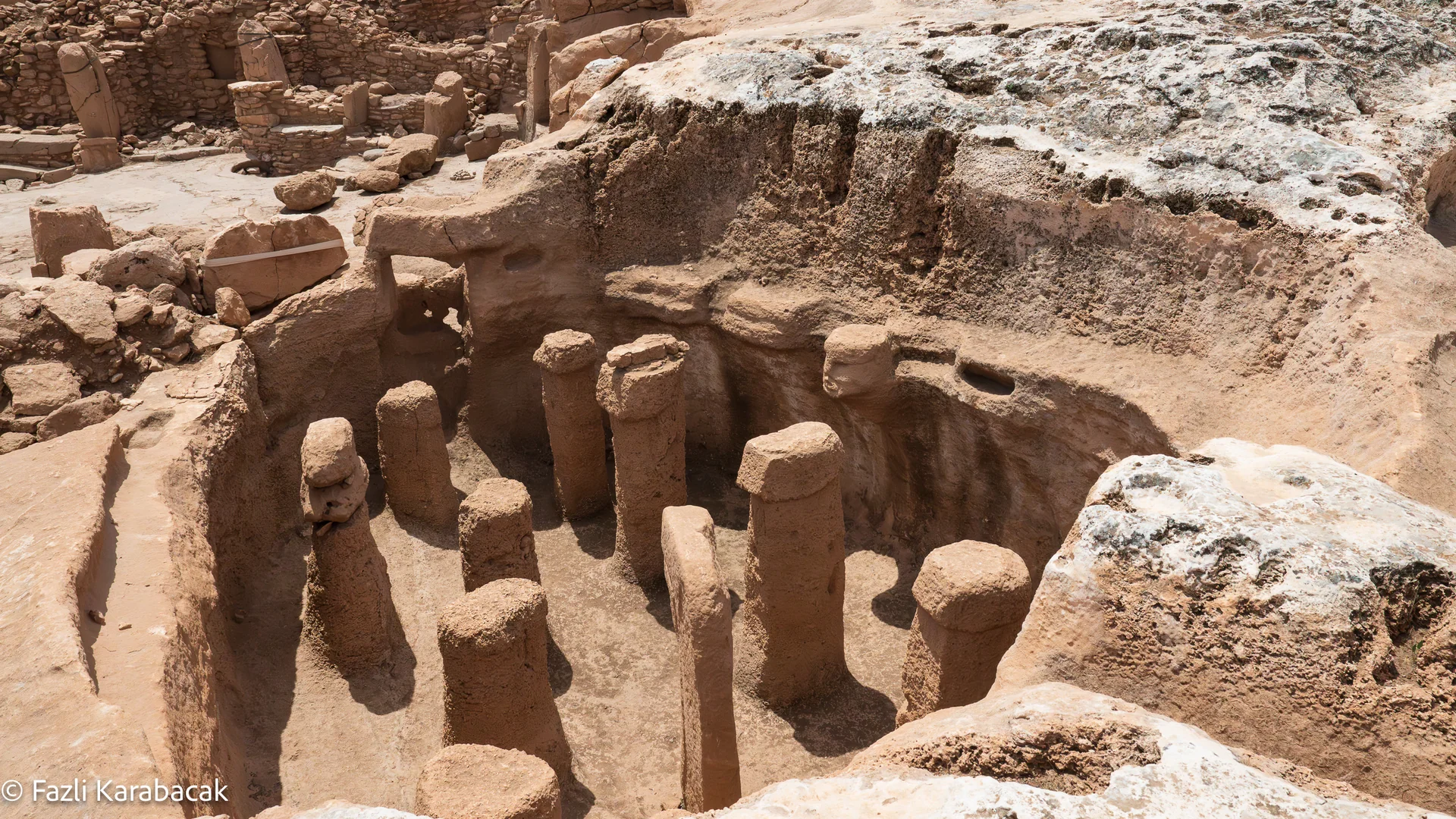
The Carved Heads of Karahantepe
Faces in Neolithic Stone
Human heads are among Karahantepe's most striking images. The best-known fixed example projects from the western wall of Structure AB. In his 2021 excavation report, Prof. Necmi Karul describes its forehead, thick lips and beard. It turns toward the entrance, with two small niches in the nearby bench.
Portable carvings and fragments must be distinguished from that architectural head, and from the separate 2.3-metre seated statue announced in 2023. All belong to the site's study of Neolithic human imagery, but their contexts and dates cannot be exchanged as though they were one object.
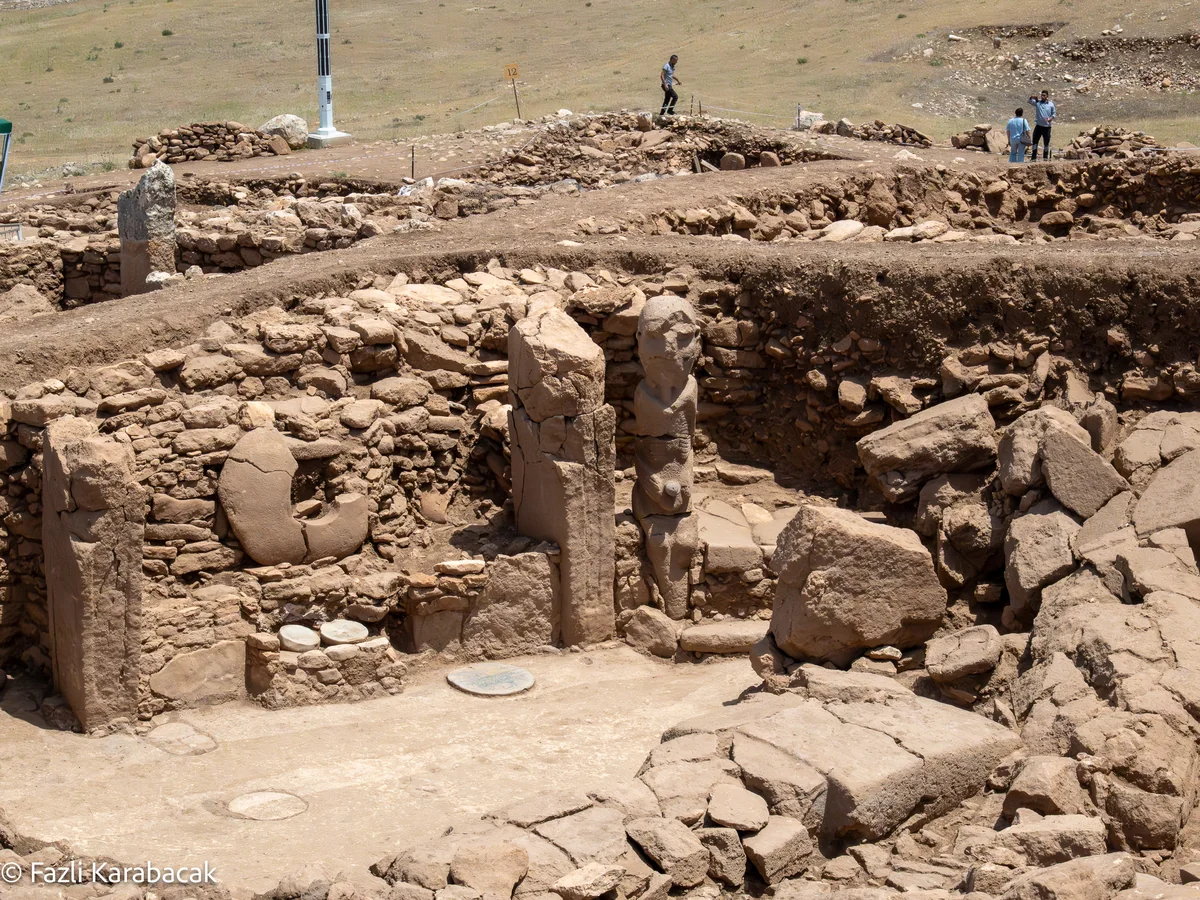
Sculpture within the excavated architecture
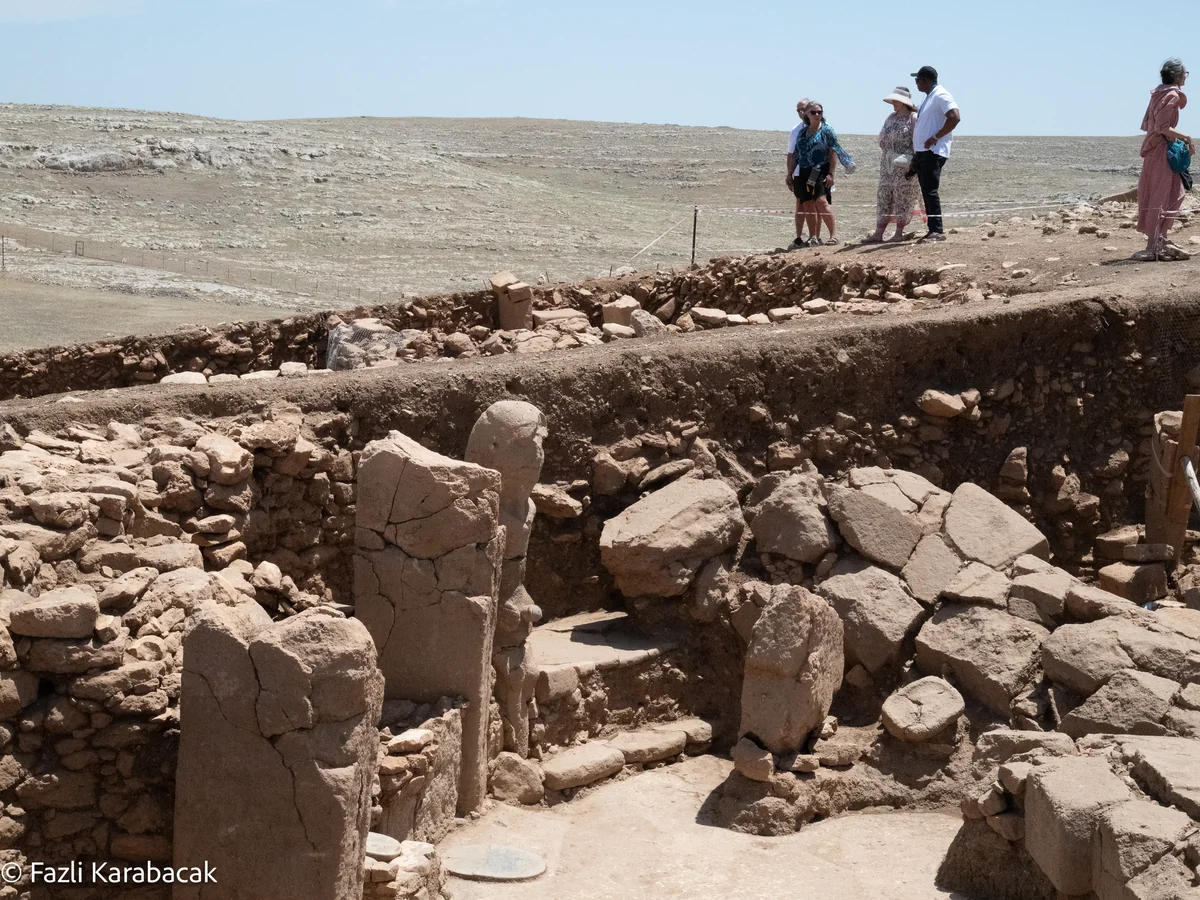
Pillars and sculpture in architectural context
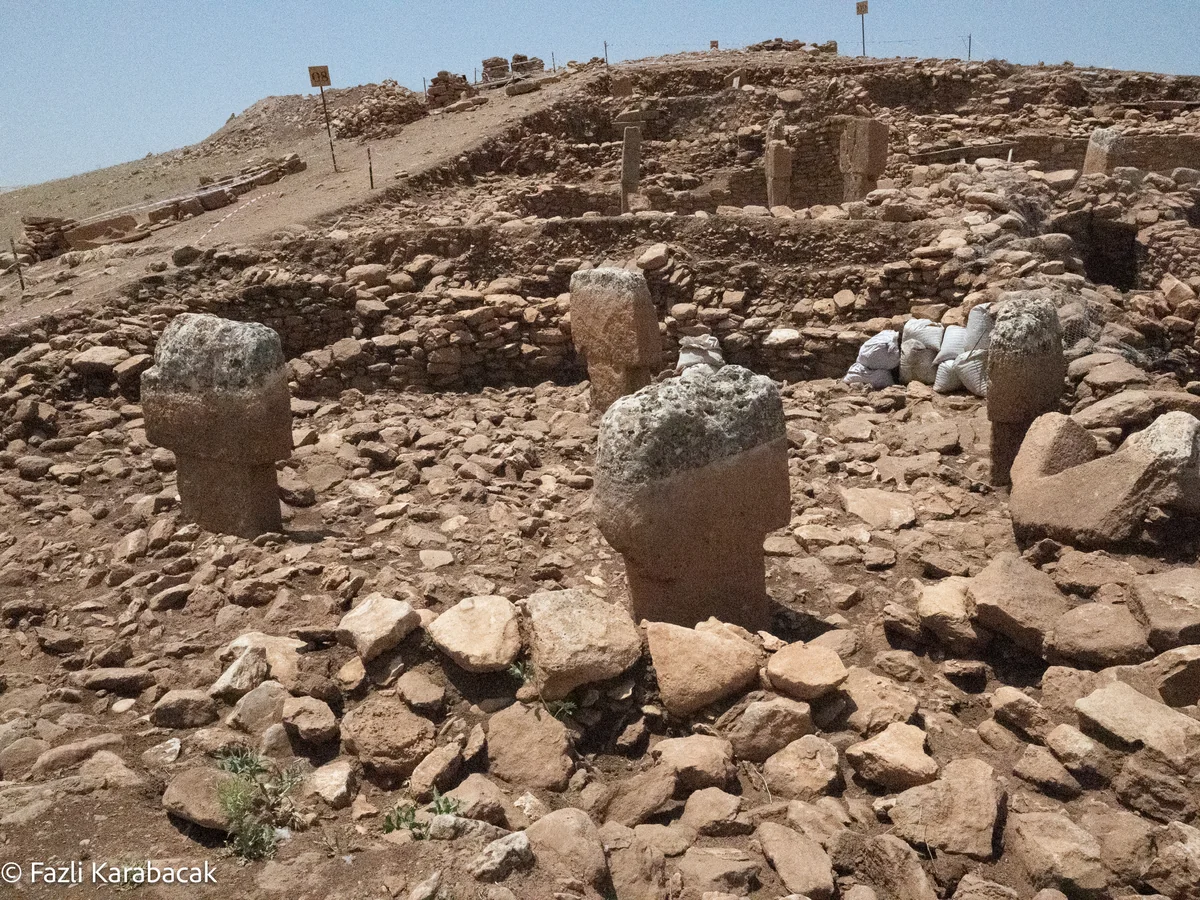
T-shaped pillars — distinct from carved human heads
Material & Technique
Limestone provided both the building material and the carving medium. Structure AB's head remains part of the bedrock wall, unlike a sculpture carved separately and brought into a building. Dimensions and carving details should be tied to individual finds rather than presented as measurements for all the heads.
The carvers worked without metal tools. Percussion and abrasion are plausible parts of limestone working, but a detailed reconstruction of technique requires examination of tool marks. Eye hollows alone do not prove that a Karahantepe carving once held inlays.
Urfa Man, found near Balıklıgöl in the 1990s, does have obsidian eyes, as documented by the official museum guide. That is a useful comparison, not evidence that the same materials were used in every Karahantepe head.
Significance in Neolithic Art
To appreciate why the Karahantepe heads matter, consider the broader context of Neolithic art. Before these discoveries, the most celebrated early portraits were the plastered skulls of Jericho and 'Ain Ghazal in the Levant, dating to roughly the same period (PPNB, c. 8500–7000 BCE). Those works achieved realism through a different technique — modelling plaster over actual human skulls — and are associated with ancestor-cult practices.
The Karahantepe heads represent an alternative path to naturalism: purely subtractive carving from a stone block, without any organic armature. They demonstrate that the impulse toward realistic portraiture was not confined to a single technique or region but emerged in multiple Neolithic communities across the Fertile Crescent. Whether particular techniques developed independently or spread through contact needs separate evidence.
Some scholars have asked whether these heads depict specific individuals — named persons within the community — or idealised types. The subtle variations between surviving examples suggest at least an awareness of individual difference, even if the intent was not portraiture in the modern sense.
Structure AB's wall head remains part of the bedrock architecture
What the Faces Tell Us
The decision to carve realistic human faces — at a time when most imagery in the Neolithic world depicted animals, geometric patterns, or highly abstracted human forms — speaks to something profound in the Karahantepe community's relationship with the body and identity.
Karul's 2021 report (PDF) proposes a ceremonial route past AB's head. Were such images portraits of the living, memorials to the dead or representations of supernatural beings? The architecture invites these questions but does not yet supply a definitive answer.
What we can say is that these carvings reveal a society deeply engaged with the question of what it means to be human. In a world where survival depended on collective cooperation, depicting a face could express identity, memory or a shared story. It does not establish when the concept of personhood first emerged.
Continue Exploring
Discover More at Karahantepe
The carved heads are just one chapter. Explore the Pillar Shrine, animal reliefs, or plan a visit to see the site for yourself.