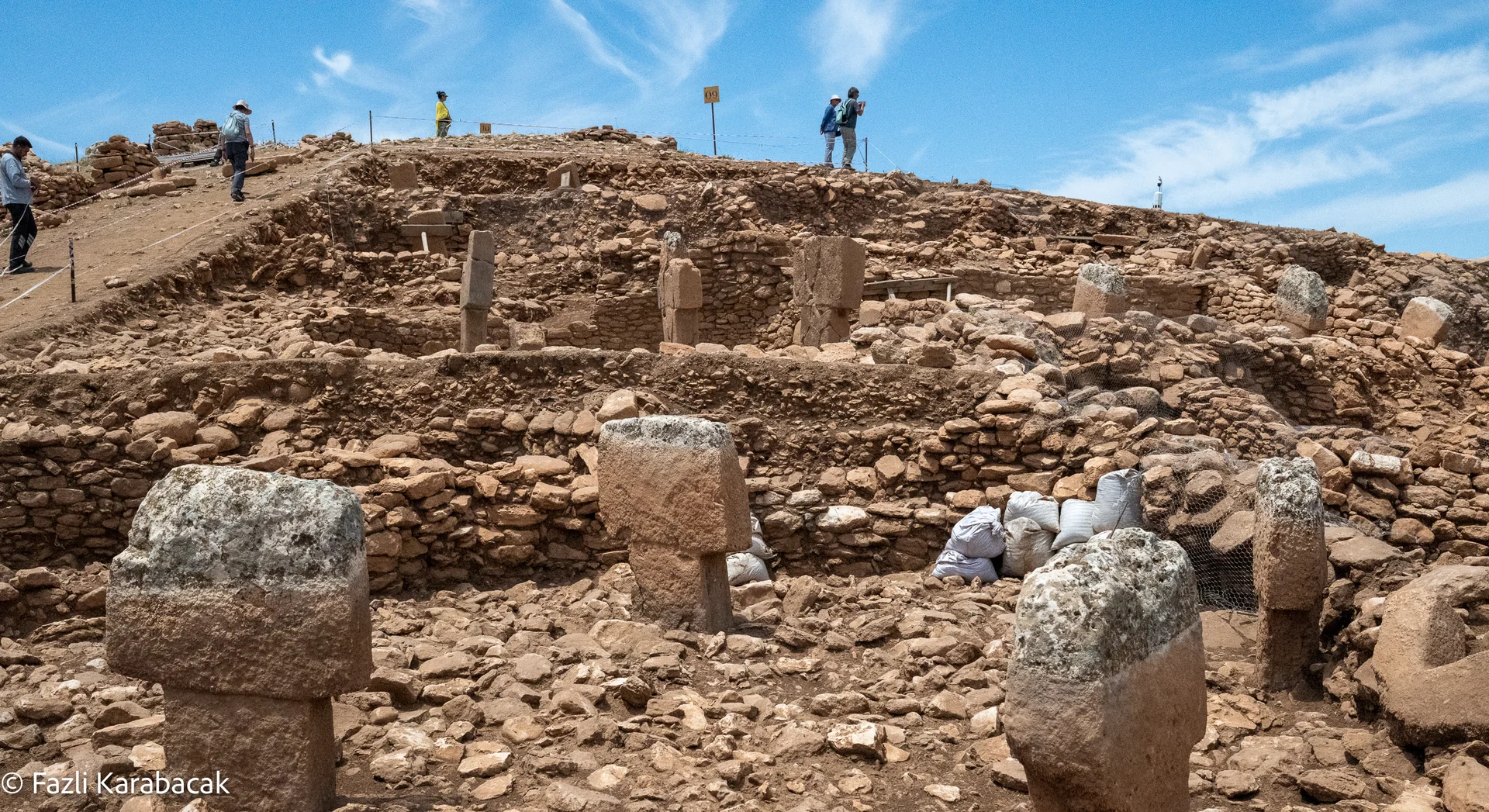
Karahantepe Discovery & Excavation Timeline
A Story Written in Stone
The story of Karahantepe spans a vast arc — from a time when woolly mammoths still roamed parts of the Northern Hemisphere, through millennia of burial and silence, to a dramatic 21st-century excavation that is rewriting the textbooks on human origins.
Unlike many archaeological sites that reveal their secrets gradually, Karahantepe burst into public consciousness with a series of stunning finds in quick succession. The carved heads, the pillar shrine, the animal reliefs — all emerged within just a few seasons of digging, a testament to how much still lies beneath the surface of Turkey's Upper Mesopotamian steppe.
The Timeline
~9600 BCE
Early Neolithic occupation
Karahantepe belongs to the early Neolithic world broadly contemporary with Göbekli Tepe. The site’s approximate chronology is not an exact construction date for every building.
~8000 BCE
Later occupation and building closure
The commonly cited occupation range extends toward 8000 BCE. Intentional filling is documented for Structure AB, but this does not establish a single burial event for the whole site or for Göbekli Tepe.
1997
First survey
Bahattin Çelik identifies the site during a surface survey of the Şanlıurfa region, recognizing its potential significance.
2019
Major excavations begin
Prof. Necmi Karul of Istanbul University begins systematic excavations. The work later becomes part of the Taş Tepeler initiative launched in 2021.
2021
Structure AB published
Karul’s report describes ten phallus-shaped bedrock pillars, an inserted eleventh stone element and a human head projecting from the western wall. Its staged filling is interpreted as intentional.
2023
Seated statue announced
On 30 September, the Ministry announces a 2.3-metre seated statue fixed into a bench, with prominent ribs, spine and shoulder bones. It is separate from Structure AB’s wall head.
2025
Human face on a T-shaped pillar
A Ministry announcement reported in October describes facial features carved on a T-shaped pillar, adding evidence to interpretations of these pillars as human representations.
The Pre-Pottery Neolithic World
To grasp the significance of Karahantepe's timeline, it helps to understand the period in which it was built. The Pre-Pottery Neolithic (PPN) spans roughly 9700–7000 BCE in the Near East, a transformative era when human societies were transitioning from mobile hunting and gathering toward sedentary life, but had not yet developed ceramic technology.
During the PPNA (9700–8700 BCE), communities in the Fertile Crescent began constructing permanent or semi-permanent structures and experimenting with plant cultivation. Karahantepe's earliest phases fall squarely in this period. By the PPNB (8700–7000 BCE), settlements grew larger, rectangular architecture became more common, and long-distance exchange networks in obsidian, flint, and seashells expanded dramatically.
Building closure needs to be assessed structure by structure. Karul interprets the successive fill layers in Structure AB as intentional. This does not establish that all of Karahantepe or Göbekli Tepe was buried together, nor that closure coincided with the adoption of agriculture or the end of the PPNB.
Rediscovery: The 1997 Survey
In 1997, Turkish archaeologist Bahattin Çelik was conducting a systematic surface survey of prehistoric mounds in the Şanlıurfa region when he identified an unusual cluster of worked stone fragments on a limestone ridge near the village of Keçili. He catalogued the site under the name Karahantepe (sometimes "Keçili Tepe") and noted its potential similarity to Göbekli Tepe, which Klaus Schmidt had begun excavating just two years prior.
For more than two decades, the site received only intermittent academic attention — a handful of survey papers, occasional surface finds. It was not until 2019 that the resources and institutional backing materialised for a full-scale excavation program.
The Taş Tepeler Project
Karahantepe's transformation from a little-known mound to a headline-grabbing excavation was catalysed by Turkey's Taş Tepeler ("Stone Hills") initiative, launched in 2021 by the Turkish Ministry of Culture and Tourism. The project recognised that Göbekli Tepe was not a solitary marvel but part of a broader network of Neolithic sites deserving coordinated study.
Prof. Necmi Karul of Istanbul University had already begun excavating Karahantepe in 2019. The later Taş Tepeler project provides a framework for comparing finds across sites — enabling researchers to trace shared architectural practices, symbolic motifs, and trade connections across the entire network.
The initiative also encompasses public engagement: visitor infrastructure, museum development, and digital documentation. The goal is both scholarly and touristic — to position southeastern Turkey as a world-class destination for understanding the origins of civilisation.
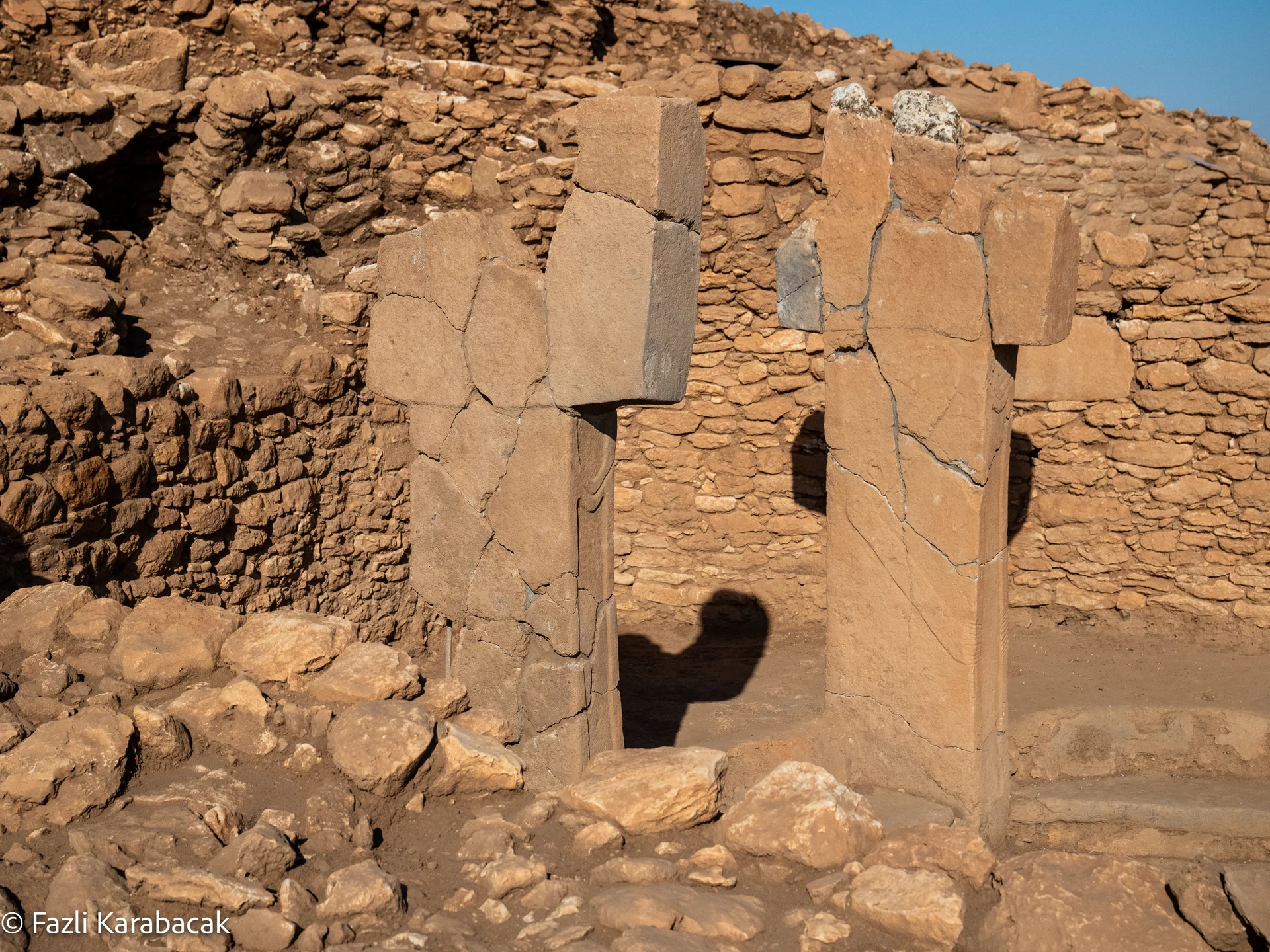
Excavation landscape at Karahantepe
The Excavation Seasons: 2019–Present
2019: Prof. Karul's team begins systematic excavation, immediately uncovering carved pillars and architectural remains that confirm the site's immense significance. Geophysical surveys reveal extensive sub-surface structures across the hilltop.
Early excavation seasons: Work on the connected AD, AB and AA structures reveals the combination of rock-cut architecture, pillars and carved imagery discussed in the three-room guide.
2021: Karul's published excavation report (PDF) documents AB's ten phallus-shaped bedrock pillars, inserted eleventh element and human head on the western wall. It also sets out the evidence for intentional filling.
2023: The Ministry's 30 September announcement describes a separate 2.3-metre seated statue fixed into a bench, with prominent ribs, spine and shoulder bones. A vulture sculpture and stone plates were found in the same area.
2025: A human face carved on a T-shaped pillar is reported in an October account of a Ministry announcement. See the 2025 season article for the distinction between this find and earlier sculptures.
Walk Where History Was Made
Stand before the pillars that Neolithic builders carved 11,000 years ago. Visit Karahantepe independently or join one of our expert-led tours for the full story behind every stone.