Quick Answer
The Sitting Man is a 2.3-metre seated human statue announced on 30 September 2023 by Türkiye’s Ministry of Culture and Tourism. The report describes it as fixed into a bench, with prominent ribs, spine and shoulder bones; a vulture sculpture and stone plates were found in the same area. It is not the head projecting from Structure AB’s western wall. The announcement does not establish an exact carving date or a “world’s oldest realistic statue” ranking. Ancestor, life-and-death and shamanic readings are hypotheses, not identified Neolithic beliefs.
There are sculptures you glance at, and sculptures that stop you cold. The Sitting Man of Karahan Tepe belongs firmly in the second category. Its exposed skeletal detail makes the human body feel both present and vulnerable. That is a response to the artwork, not proof of what its makers intended.
As a licensed professional tour guide specialising in archaeology and mythology, with 23 years of professional guiding, I want to keep that distinction clear: what we can see, what the excavators report, and what we imagine are not the same thing.
What the 2023 Announcement Confirms
The official Ministry report identifies a seated statue 2.3 metres high, anchored to the floor within a bench. It highlights a realistic facial expression and the prominent ribs, spine and shoulder bones, which the report compares to a deceased human body.
The same announcement describes a vulture sculpture set into a wall and stone plates on the floor in the same area. It does not provide the three-fragment reconstruction history, a named “soul hole” behind the figure, or the precise carving date sometimes attached to online accounts. Those details should not be repeated as established facts without a find-specific source.
Physical Description
The statue depicts a seated human figure with detailed anatomy. Damage to a sculpture, where present, cannot by itself demonstrate ritual “killing”: breakage, burial, weathering and later disturbance must also be considered.
The most striking feature is the chest. Visible ribs and other bony features draw attention to the body beneath the skin. The Ministry’s comparison with death makes a life-and-death interpretation worth discussing, but an artistic resemblance is not a diagnosis of starvation or a record of a specific mortuary ceremony.
The hands and genital area also figure in interpretations of fertility and vitality. Claims about intended proportions, finger counts or engineering choices require closer documentation than the official announcement supplies.
Not the Head in Structure AB
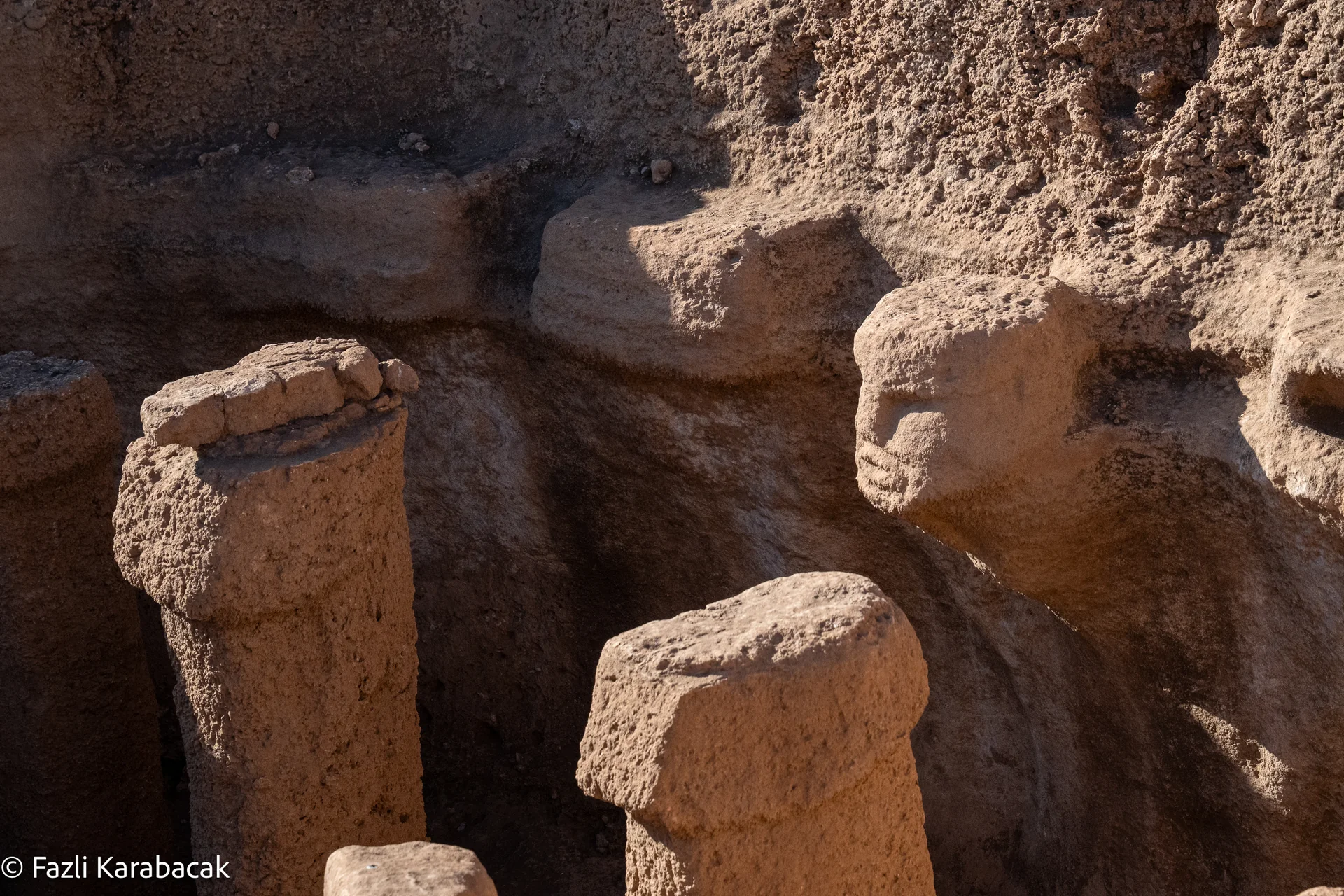
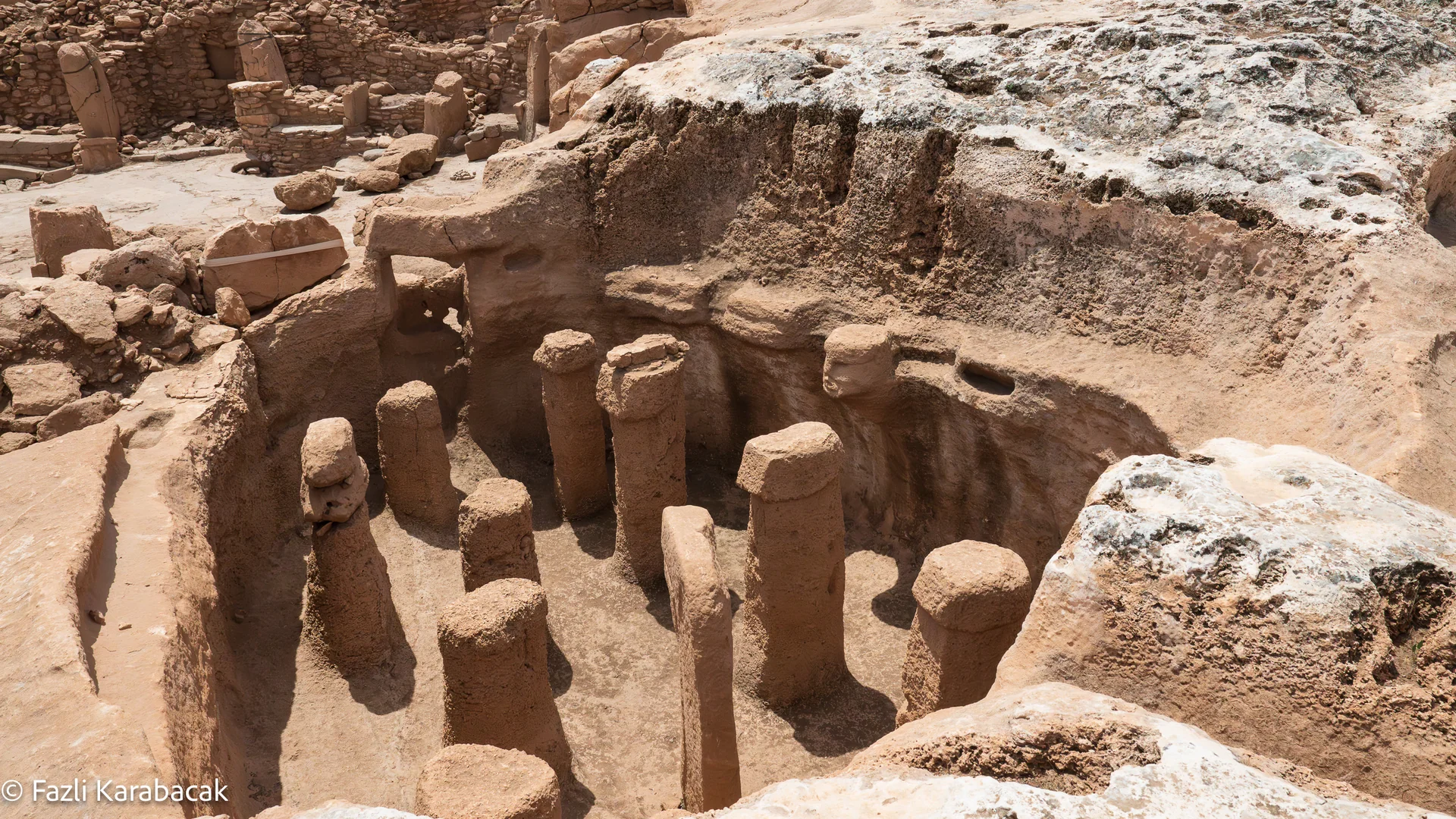
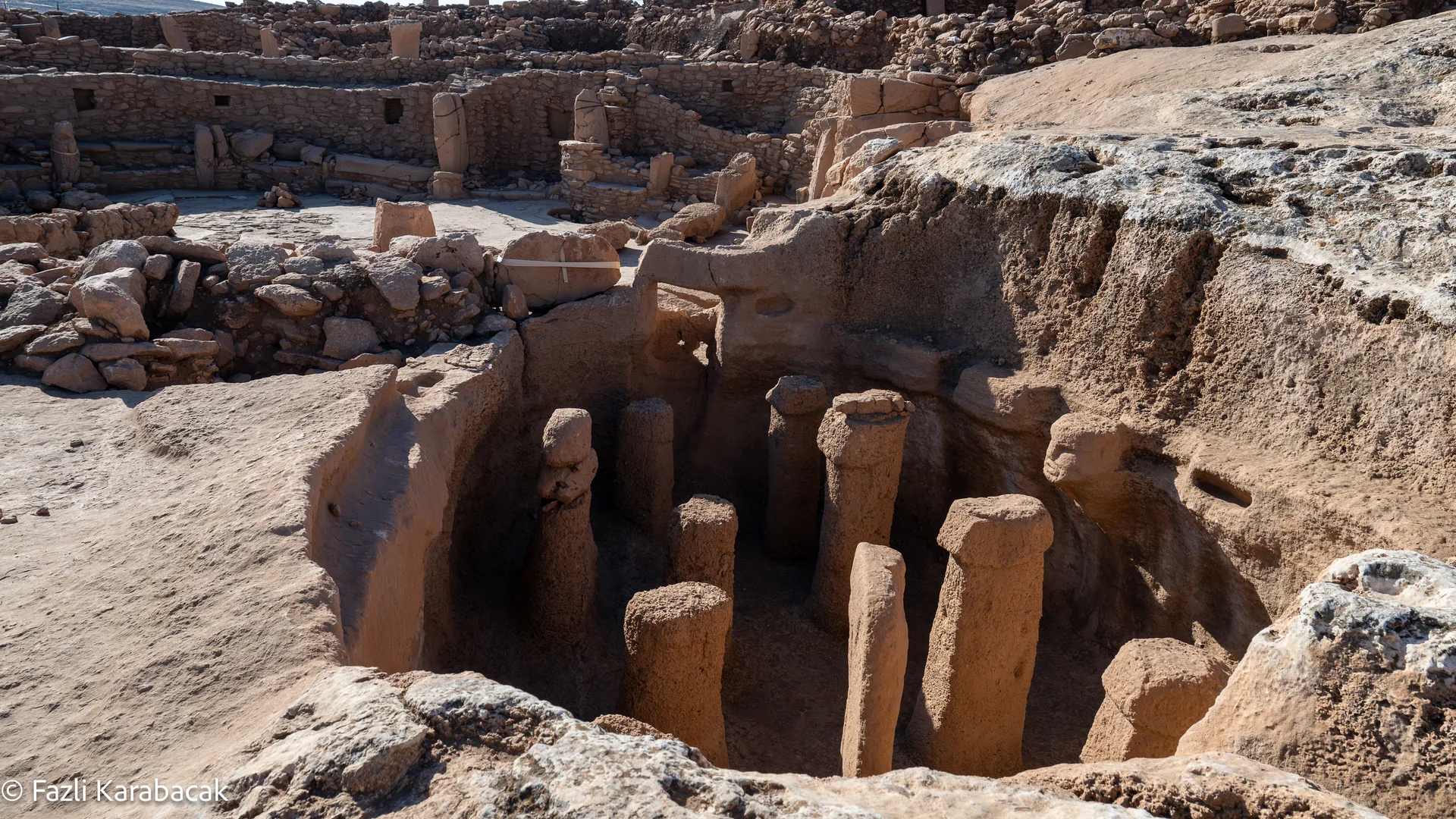
The Pillar Shrine, Structure AB, has a human head carved out of its western wall. Karul’s 2021 report (PDF) describes ten phallus-shaped bedrock pillars and an inserted eleventh stone element. It does not describe the seated, ribbed figure at the centre of that room.
Keeping these two discoveries separate matters. Otherwise, the 2023 statue’s anatomy becomes attached to the 2021 chamber plan, creating a monument that the excavation reports do not describe.
How Old Is the Statue?
The statue belongs to Karahan Tepe’s Pre-Pottery Neolithic context. The site’s broad chronology, often given as approximately 9600–8000 BCE, is not a direct date for carving this object.
Oxford’s radiocarbon guide explains that radiocarbon dates organic material, such as charcoal or bone, not the manufacture of a limestone statue. Associated samples, their stratigraphic relationship and archaeological comparison can constrain a statue’s context. They do not automatically tell us the year a sculptor worked the stone.
Nor was large-scale human sculpture unknown before this discovery. The official Şanlıurfa Museum guide documents Urfa Man, a 1.8-metre limestone figure with obsidian eyes discovered in the 1990s. That earlier discovery is an important comparison, not a settled ranking of the two objects’ carving dates.
Interpretations: What Does the Sitting Man Mean?
The Ancestor Hypothesis
One interpretation reads the exposed bones as an ancestor or deceased person. That is plausible as a question, not an identification. Assigning ribs to numbered layers of the sky goes beyond the reported evidence.
The Fertility-Death Duality
Comparing skeletal imagery with signs of vitality is one way to explore the sculpture. The comparison with Peruvian Carcancha figures is a modern cross-cultural analogy. It does not establish that Karahan Tepe’s makers used the same concept or had contact with those much later societies.
The Gesture Language Theory
Reading posture and hand placement as a coded language is another speculative approach. Without an independently established system of signs, claims that the eyes mean Venus or the ears mean east and west cannot be treated as translations.
The Shamanic Reading
A shamanic reading may be evocative, but neither the seated posture nor the skeletal appearance establishes trance practice. An unverified “soul hole” should not be used as evidence for it.
What I Tell My Tour Groups
My guiding approach is to start with the discovery record, then explain how interpretations differ in evidential support. The statue remains powerful without a claim to be the first portrait or a decoded message from prehistory.
Where to See the Sitting Man
The Şanlıurfa Archaeological Museum offers essential regional context, and Karahan Tepe explains the architecture. Confirm the original statue’s current display location directly with the museum or site before travelling; the 2023 discovery report does not establish where it is displayed today. Use the visitor guide to plan access.
Frequently Asked Questions
How tall is the Karahan Tepe Sitting Man? The Ministry’s 2023 announcement gives a height of 2.3 metres (about 7.5 feet).
How old is the Sitting Man statue? It belongs to the Pre-Pottery Neolithic. The site’s broad date range is not a precise carving date, and limestone cannot be directly radiocarbon-dated to determine when it was carved.
Why does the statue have visible ribs? The prominent ribs are recorded, but their intended meaning is unknown. Ancestor, death and fertility readings remain hypotheses.
Where can I see the Sitting Man? Confirm its current location with the Şanlıurfa Archaeological Museum or site management. Do not assume that discovery at the site means an original or replica is currently on public display there.
Is the Sitting Man the oldest human statue? The cited official report does not establish that ranking. Urfa Man and other Neolithic sculpture must be considered; “realistic” is also an interpretive description, not a precise chronological category.