Quick Answer
Hugh Newman and J.J. Ainsworth report that sunrise light near the winter solstice illuminated Structure AB’s western-wall head during a visit on 20 December 2021. Their account proposes an intentional ancient alignment. The modern observation and the builders’ intention are separate questions: original roofing, openings, the horizon and building phases all need assessment. This article treats the interpretation as a hypothesis, not a verified Neolithic calendar or the world’s oldest alignment. Using the often-cited comparison dates of 9000 BCE and 3000 BCE gives 6,000 years, not 7,000.
In their account published in 2022 and updated in 2023, Newman and Ainsworth describe sunlight moving across the head near the winter solstice for roughly 45 minutes. It is an intriguing observation, and one worth distinguishing from the stronger claim that the builders intentionally designed the same effect.
An excavated building is not identical to a building in use. Walls, roofs, neighbouring structures and the local horizon can determine whether a light path was possible in antiquity.
As a guide, I find the possibility compelling precisely because it can be tested. We do not need to call it proven to explain why people are interested.
How the Proposed Alignment Works
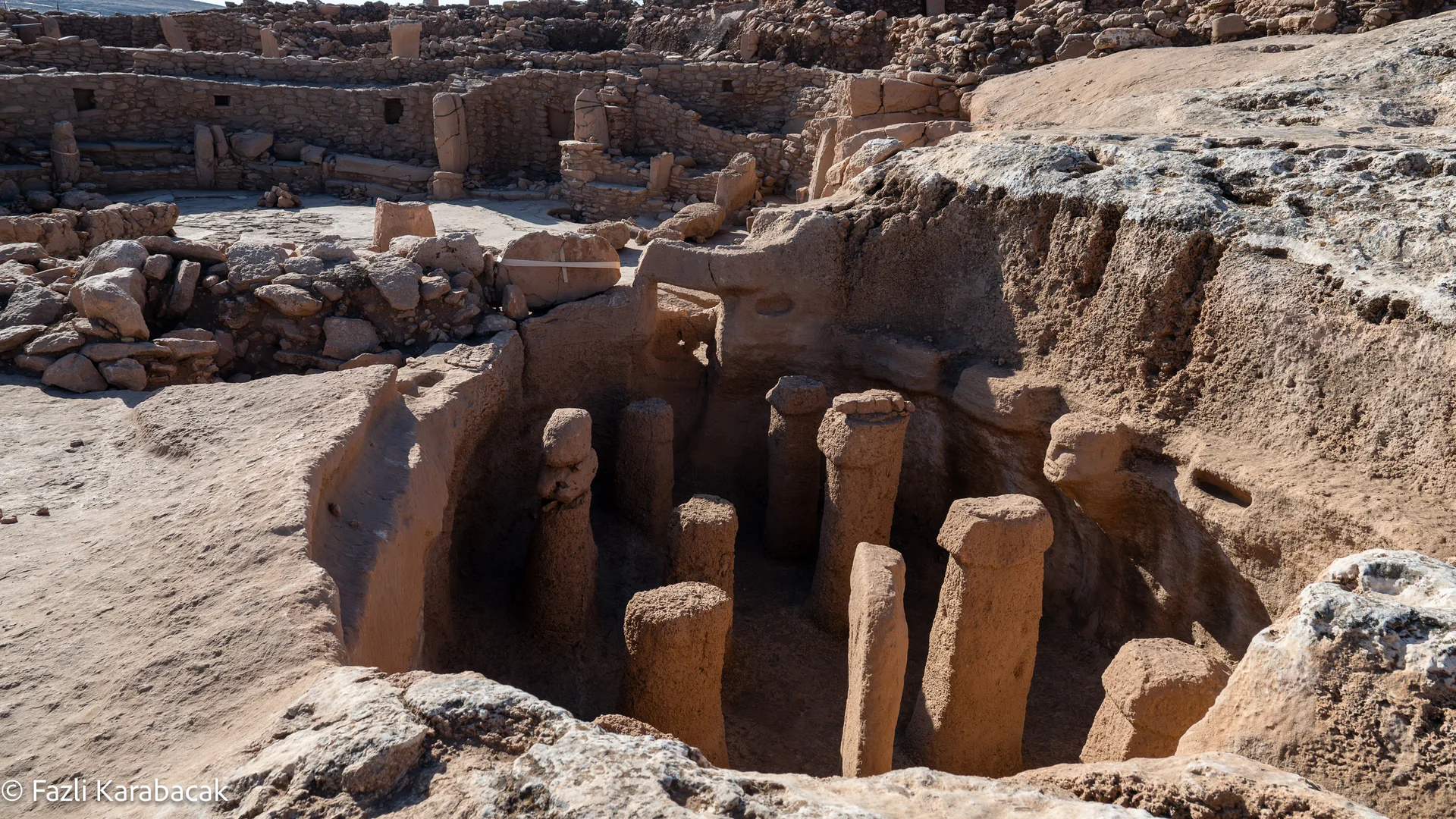
The mechanics are elegant in their simplicity. Structure AB is a trapezoidal enclosure roughly 7 meters long and 6 meters wide, cut into the bedrock. In its southeast wall, a rectangular porthole about 70 centimeters wide opens toward Structure AD. On the opposite western wall, a carved stone head projects from the rock.
The proposed light path passes from the direction of Structure AD through the opening toward AB’s head. T-shaped pillars in AD should not be confused with AB’s ten phallus-shaped bedrock pillars and its separately inserted eleventh element.
The authors also discuss astronomical calculations for an assumed date around 9000 BCE. A modelled ancient solar position does not independently establish that date for the structure or prove its intended function. Precise modern clock times should not be presented as ancient local time.
The Carved Stone Head
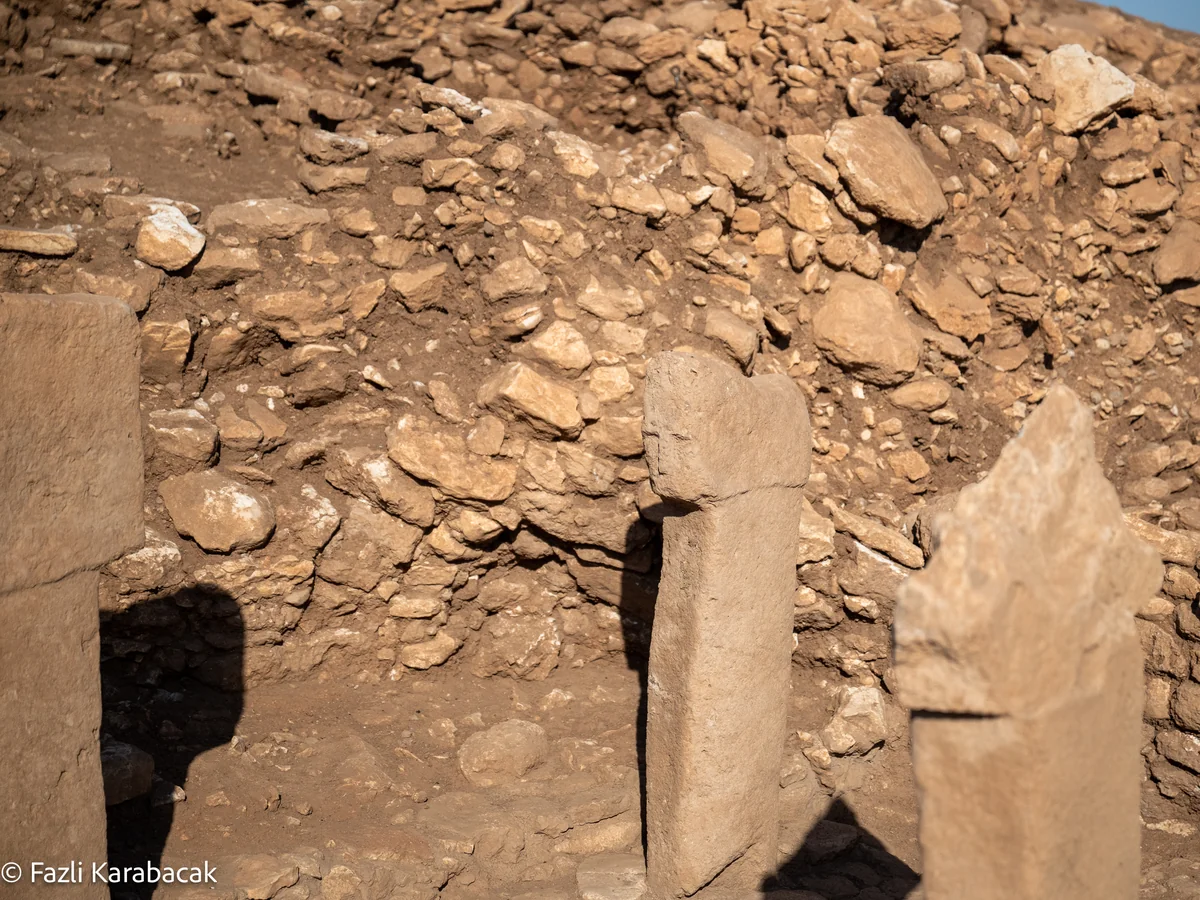
The head is a recorded archaeological feature. In Karul’s 2021 report (PDF), it projects from the western wall and turns slightly toward the entrance stairs. The report describes two nearby niches and ten bedrock pillars plus an inserted eleventh element; it does not establish an astronomical function.
There is something affecting about imagining winter light touching a carved face. Rebirth or renewal is a modern interpretive possibility, not a message recovered from the builders. The head is also distinct from the seated statue announced in 2023.
A Neolithic Calendar in Stone?
The winter solstice alignment has led some researchers to propose that Structure AB functioned as a calendar. A hypothesis put forward by Martin Sweatman suggests that the 11 pillars in Structure AB may have calendrical significance. Under this model, the stone head represents either the final lunar month or the first day of a new annual cycle.
The arithmetic must be kept straight: eleven lunar months of approximately 29.5 days plus eleven days total 335.5 days, not a solar year. Twelve lunar months give roughly 354 days; adding eleven gives roughly 365. Choosing that second model does not demonstrate that eleven pillars encoded it.
A calendar interpretation requires evidence for how days or months were counted and how any intercalation worked. A numerical resemblance and a reported light effect are starting points for a hypothesis, not its confirmation.
What Would Strengthen the Hypothesis?
Independent surveys should test the opening’s orientation, the ancient horizon, possible roofs and the chronology of surrounding structures. Observations on days before and after the solstice would help establish whether the effect is specific to that date or occurs over a broader season.
Comparisons with Newgrange or Stonehenge also require phase-specific dates and comparable standards of evidence. Even if one uses 9000 BCE for Karahan Tepe and 3000 BCE for Stonehenge, the difference is 6,000 years. Those rounded dates do not establish the age of either specific alignment.
For me, the responsible story is not “everything has changed,” but “here is a question that further archaeological and astronomical work could answer.” The wider star-alignment theories deserve the same distinction.
Visiting During the Winter Solstice
If you are planning a trip to Karahan Tepe and have flexibility in your schedule, December is worth considering. The winter solstice typically falls on December 21 or 22. Southeastern Turkey in December is cold — temperatures in the Tektek Mountains can drop near freezing — but the landscape has a stark beauty that summer visitors never see.
Do not assume that dawn entry, access inside Structure AB or a view of the reported light path is available. Confirm current rules with site management and consult the visitor guide. Weather and conservation arrangements can also affect visibility.
Frequently Asked Questions
What is the winter solstice alignment at Karahan Tepe? It is a hypothesis based on a reported modern sunrise illumination of AB’s western-wall head near the winter solstice. Ancient intentionality and the original light path are not established by the observation alone.
Is the Karahan Tepe solstice alignment older than Stonehenge? Karahan Tepe is much earlier as an archaeological site, but a specific intentional alignment has not been securely established. The comparison 9000 BCE versus 3000 BCE gives 6,000 years, not 7,000.
When was the solstice alignment discovered? Newman and Ainsworth describe an observation on 20 December 2021 in an account first published in 2022. That is a date of modern observation, not the construction date of an ancient astronomical device.
Can visitors see the alignment? Do not assume sunrise access or visibility is available. Check permission, current conservation arrangements and weather before planning a solstice visit.
Does this prove the builders had astronomical knowledge? No. The report raises a testable possibility; establishing intentional design requires archaeological reconstruction and independent assessment, not simply a modern illumination.