Quick Answer
Snakes are the dominant animal carving at Karahan Tepe, appearing far more frequently than any other motif on the T-shaped pillars — a feature that distinguishes the site from Göbekli Tepe’s more diverse bestiary. Beyond snakes, the site contains leopard reliefs with incised claw marks suggesting motion, high-relief lion figures, fox carvings, and depictions of gazelles and rabbits that reflect the region’s fauna. The most dramatic serpent representation is the human-serpent hybrid head protruding from Structure AB’s wall, positioned at the focal point of the winter solstice alignment. While snakes appear across ancient cultures worldwide, Karahan Tepe’s serpent dominance suggests the animal held special cosmological significance — possibly representing renewal, the boundary between earth and underworld, or a totemic clan symbol.
The first time I noticed a snake carved into one of Karahan Tepe’s pillars, I had to lean in close to be sure of what I was seeing. The relief was worn by eleven millennia of weather, but the sinuous curve was unmistakable — a serpent crawling vertically up the side of a T-shaped monolith, frozen in limestone forever.
After visiting the site regularly since 2020, I have come to think of Karahan Tepe’s animal carvings as a language we can see but not yet fully read. Each figure was placed deliberately, carved with effort and intention by people using nothing but stone tools. Understanding what these animals meant to their creators is one of the great challenges of Neolithic archaeology.
The Dominance of the Snake
If Göbekli Tepe is known for the diversity of its carved animals — vultures, scorpions, boars, foxes, spiders — Karahan Tepe has a clear favorite: the snake. Serpent reliefs appear more frequently than any other motif on the site’s T-shaped pillars.
The snakes at Karahan Tepe are typically carved in relief on the sides of pillars, often depicted as if moving upward. Some show naturalistic proportions; others are more stylized. A stone bowl fragment recovered from the site features a zigzagging snake motif that demonstrates the consistency of this iconographic theme across different object types.
The serpent’s prominence raises obvious questions. Was it a totemic animal for the community that built the site? Did it represent a cosmological concept — the boundary between earth and underworld, the cycle of renewal symbolized by shedding skin? The serpent is among the most universally powerful symbols in human culture, and its dominance at Karahan Tepe predates all known mythological traditions by thousands of years.
The Human-Serpent Head
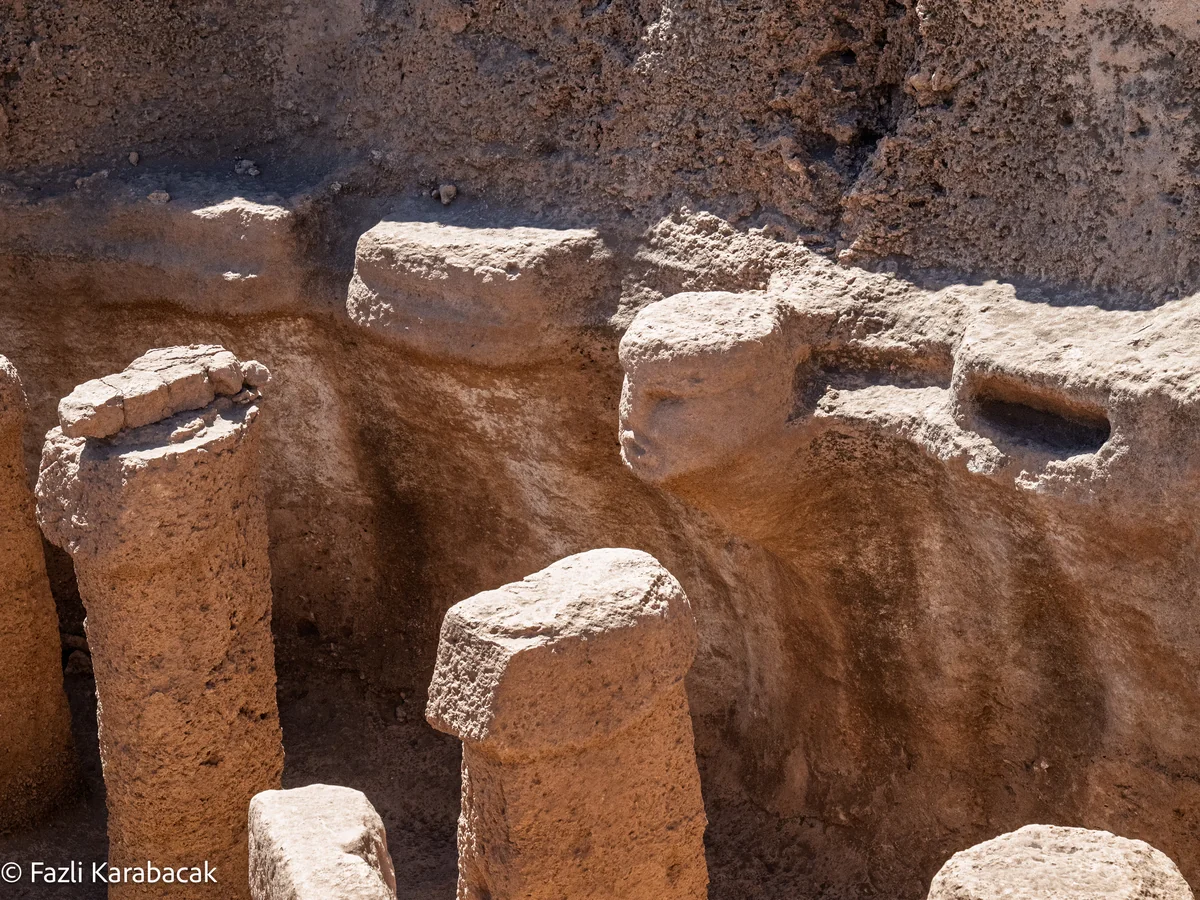
The most dramatic expression of serpent symbolism at Karahan Tepe is the carved head protruding from the western wall of Structure AB. This is not simply a snake — it is a hybrid figure, combining human facial features with a serpent-like form. The head has carved eyes and an open mouth, and its position at the focal point of the winter solstice alignment suggests it held supreme ritual importance.
In the context of the Kabbalistic interpretation of Structure AB, this head corresponds to Samael — the great serpent figure associated with the boundary between the divine and material worlds. Whether or not one accepts that specific interpretation, the placement and hybrid nature of this carving confirm that the snake was not just an animal to the builders of Karahan Tepe. It was something more.
Lions and Leopards
A high-relief lion or leopard figure has been found on one of the pillars at Karahan Tepe. Similar feline imagery appears on the buttresses of Structure AD, where leopard or fox-like creatures are carved into the stone surfaces.
At Göbekli Tepe, big cats appear on several pillars, often in positions that suggest guardianship or authority. Çatalhöyük, the famous Neolithic settlement in central Turkey dating to roughly 7,500 BCE, features the celebrated image of a woman seated between two leopards — perhaps the earliest known “Mother Goddess” representation. The feline imagery at Karahan Tepe fits within a broader Neolithic tradition that associated big cats with power, protection, or spiritual authority.
Foxes and Their Significance
Fox imagery appears at both Göbekli Tepe and Karahan Tepe. At Göbekli Tepe, the fox is one of the most frequently depicted animals, appearing in prominent positions on major pillars. Some researchers have suggested that the fox held particular totemic importance for the communities that built these sites — possibly representing cunning, liminality (the fox moves between day and night, settlement and wilderness), or specific clan identities.
Gazelles and Rabbits
Smaller prey animals also feature in Karahan Tepe’s carved repertoire. Gazelles and rabbits have been identified among the relief carvings, and their bones are prominent in the faunal assemblage from excavations. These animals would have been primary food sources for the hunter-gatherer communities and their depiction may reflect both practical importance and symbolic meaning.
The gazelle in particular is the most commonly found animal in Neolithic bone deposits across the Şanlıurfa region. Its representation in stone may simply honor a creature that sustained human life — or it may carry deeper significance related to speed, grace, or the cycle of hunting and renewal.
The Seasonal Calendar Interpretation
One of the more ambitious interpretive frameworks suggests that the animal carvings at both Göbekli Tepe and Karahan Tepe function as seasonal markers tied to astronomical cycles. Under this model, different animals correspond to different times of the year, with the vulture marking summer (associated with Cygnus), the bull marking spring (Taurus), the scorpion marking autumn (Scorpio), and the snake marking a spring renewal cycle.
If correct, this would mean the T-shaped pillars function not just as monuments but as components of a living calendar — a stone almanac encoding the rhythms of the natural year. The theory is controversial but gains some support from the documented astronomical alignments at the site.
What I Point Out to Visitors
When I guide groups through Karahan Tepe, I spend considerable time at the carved pillars. Many of the reliefs are subtle — you need to know where to look and how to read the surface of the stone. Raking light (early morning or late afternoon) is essential for seeing the carvings clearly.
I tell people to look for the snakes first — they are the most common and the easiest to identify. Then look for the smoother, larger surfaces where bigger animals were depicted. And pay attention to the placement: which side of the pillar faces inward (toward the center of the enclosure) and which faces outward. The positioning was intentional, and it may tell us something about the symbolic hierarchy of the animals represented.
Frequently Asked Questions
What is the most common animal carving at Karahan Tepe? The snake. Serpent reliefs appear more frequently than any other animal motif on the T-shaped pillars.
Are the carvings at Karahan Tepe the same as at Göbekli Tepe? There is overlap, but Karahan Tepe is more serpent-dominated while Göbekli Tepe features a wider variety of animals including vultures, scorpions, boars, and foxes.
What does the snake symbolize at Karahan Tepe? Interpretations vary: renewal and rebirth (skin shedding), earth/underworld connection, a totemic clan animal, or a cosmological boundary figure. The hybrid human-serpent head in Structure AB suggests the snake had deep ritual significance.
Can visitors see the carvings clearly? Yes, though some reliefs are weathered. The best viewing conditions are in early morning or late afternoon light, which creates shadows that reveal the carved details.